
Inspection planning guide
First Article Inspection Report Guide
What a first article inspection report contains, how AS9102 FAIR forms are organized, and what to request in a machining RFQ.
Short answer
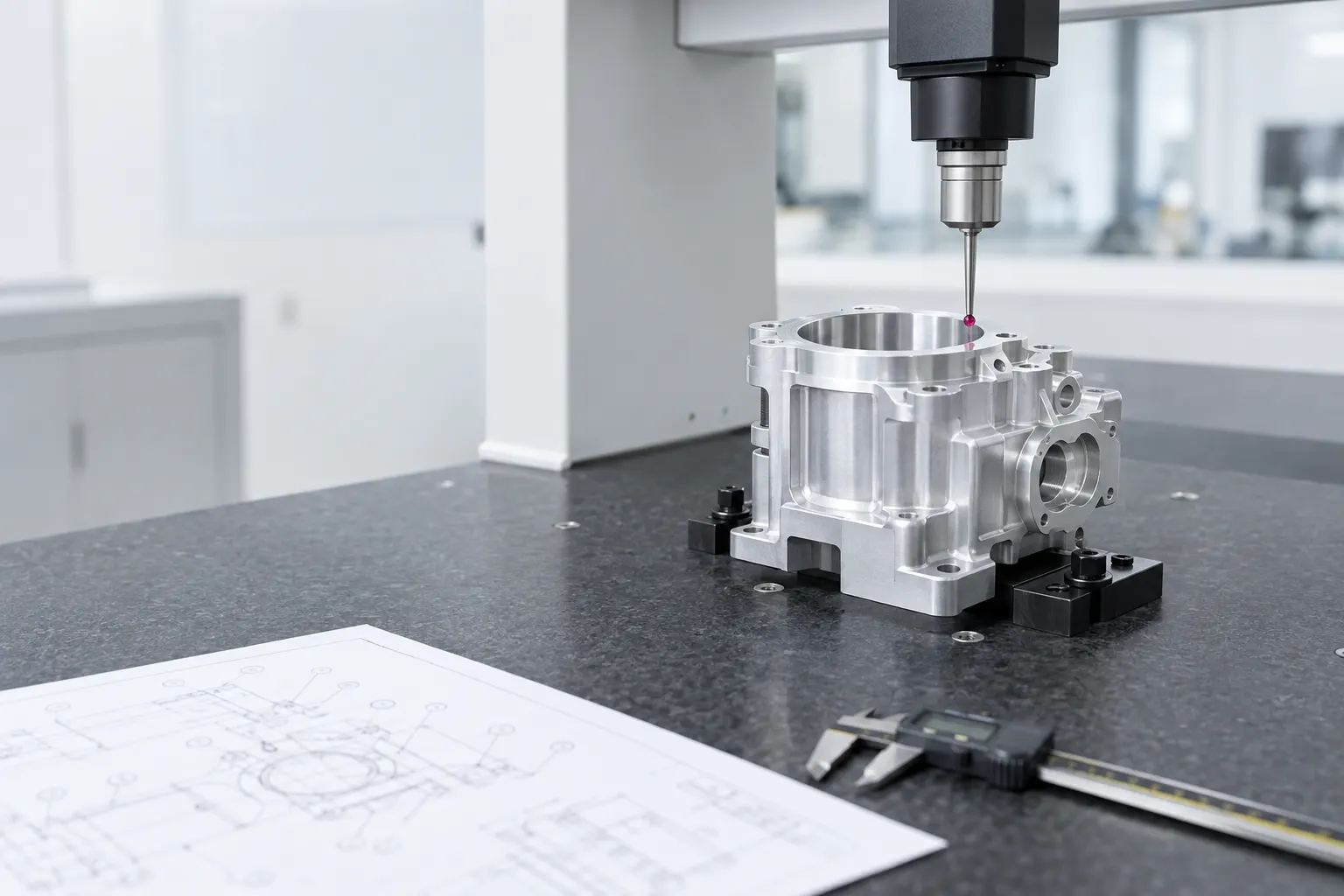
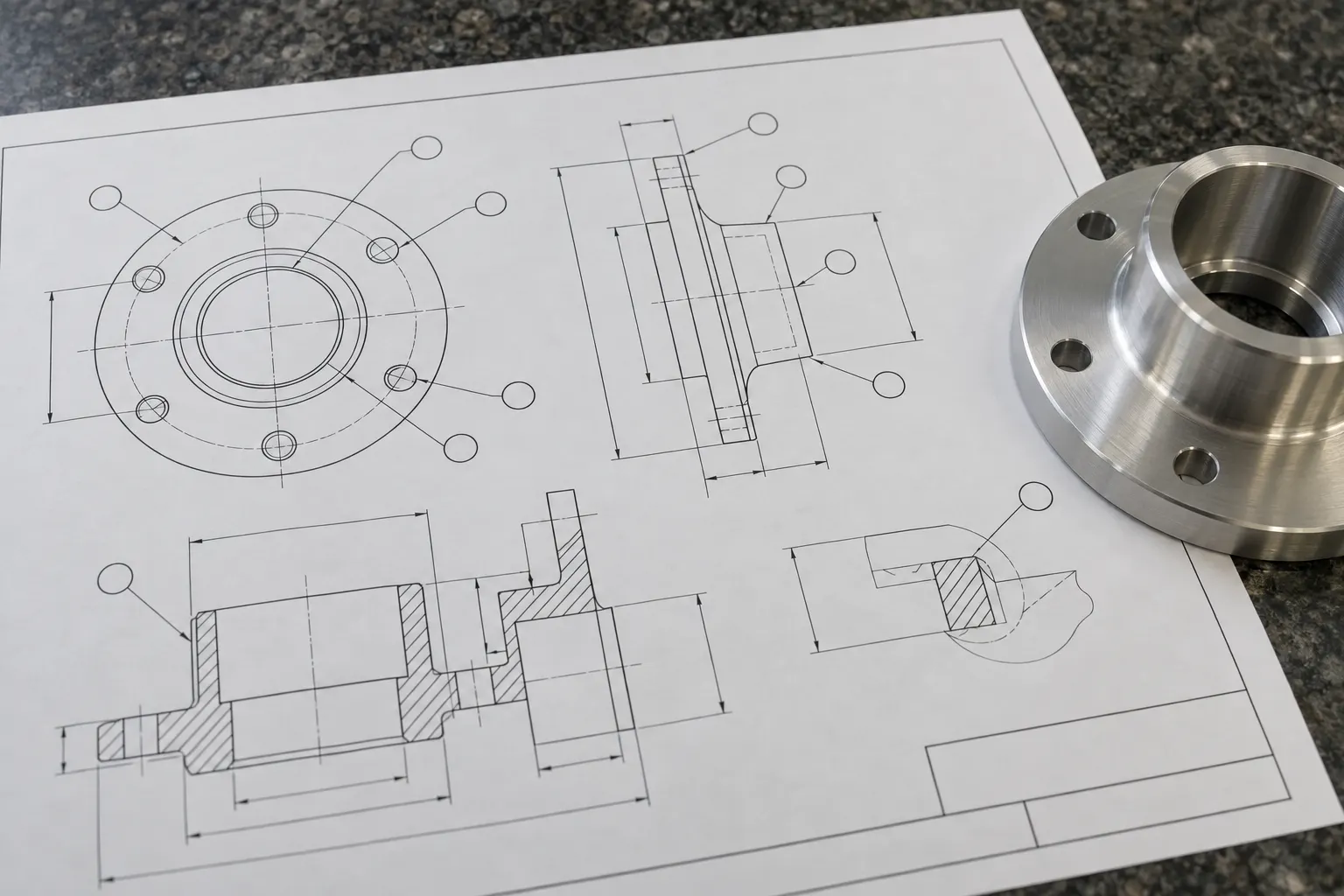
A first article inspection report (FAIR) is the documented check of the first part made by the production route against every requirement on the released drawing. Each characteristic is numbered on a ballooned drawing and listed in the report with its requirement, measured result, and acceptance. Ask for it in the RFQ, because the format and sample size change the quote.
First article inspection answers one question: can this route, with this material, these machines, and this drawing revision, make a conforming part? It is not a substitute for in-process or lot inspection, and it is not the same as a dimensional report on a few critical features. The most common disputes come from mismatched expectations, such as a buyer expecting a full AS9102 package while the supplier quoted a short dimensional sheet, so the format belongs in the RFQ.
Applicability
First Article Inspection Report use cases
New parts, or parts made by a new supplier or at a new manufacturing location, before production quantities are released.
Repeat parts after a drawing revision, a material or special-process change, or a long production gap, if the contract requires a new FAI.
Aerospace and defense orders where AS9102 forms are a contract requirement, and other industries that borrow the same structure.
Prototype-to-production transitions where the prototype measurements are not enough to approve the production route.
RFQ inputs
RFQ inputs and drawing requirements
Required format
State whether the order needs AS9102 forms, a customer-specific FAI template, or a simple dimensional report, and attach the template if it is your own.
Ballooned drawing ownership
Say whether you will supply a ballooned drawing or expect the supplier to balloon it, and whether balloon numbers must match your existing system.
Scope of characteristics
Confirm that every drawing characteristic is in scope, including notes, finish, marking, and material requirements, not only dimensions.
Sample size and parts
State how many first-article parts are measured, whether they ship with the order, and whether they are tagged or segregated.
Supporting records
List the material certificates, special-process certificates, and functional test records that must accompany the report.
Constraints
Constraints and quote assumptions
- A full FAIR on a complex part can take longer than machining a prototype, so it should be quoted as a deliverable, not assumed to be free.
- Notes on the drawing such as finish, cleanliness, marking, or edge break are characteristics too; leaving them out produces an incomplete report.
- Measurement method and equipment should suit the tolerance; a report full of results near the tolerance limit measured with an unsuitable gauge is not useful evidence.
- If the drawing revision changes after the FAI, the report covers the old revision, and the order should say whether a partial or full FAI is required.
Reference
What the specification has to state
| Field | What it records | If it is missing |
|---|---|---|
| Characteristic number | The balloon number on the drawing | A result cannot be traced back to the requirement it proves |
| Requirement | The nominal and tolerance, or the note text, exactly as drawn | The report checks against a remembered value instead of the drawing |
| Measured result | The actual value, or conforms / does not conform for attributes | Acceptance rests on a tick mark rather than evidence |
| Method or gauge | The instrument or method used, such as CMM, gauge, or visual | A borderline result cannot be judged or repeated |
| Accept / reject | The decision for that characteristic | Nonconforming features are not visible at a glance |
| Drawing revision | The revision the whole report was checked against | The report may describe a part that is no longer current |
Published standards
Where these terms are defined
These define the terms this page uses. ProtoRFQ claims no approval under any of them; the standard that governs a project is the one named in the RFQ.
- SAE AS9102 — the aerospace first article inspection requirement that defines the three FAIR forms.
- ASME Y14.5-2018 — the GD&T standard behind the characteristics a FAIR has to account for.
Related manufacturing examples
Related manufacturing references

Machined Cavity Block
Machined Cavity Block is the kind of part with many characteristics, where a ballooned drawing keeps the FAI complete.
Review reference
Drilled Manifold Plate
Drilled Manifold Plate shows why hole positions, thread callouts, and port notes all need their own balloon numbers.
Review reference
Machined Actuator Housing
Machined Actuator Housing combines bores, faces, and finish requirements that a first article report has to account for.
Review referenceRelated pages
Continue the RFQ review
Quality approach
How inspection scope, change control, and evidence are agreed at the RFQ stage.
Open pageTolerances and standards
What a tolerance callout has to state before it can be quoted or inspected.
Open pageInspection planning worksheet
A worksheet for listing the characteristics and records an order needs.
Open pageFAQ
First Article Inspection Report FAQs
What is a first article inspection report?
It is the record that the first production-route part was measured and checked against every requirement on the released drawing. It links each balloon number to a requirement, a measured result, and an accept or reject decision, together with the material and process records behind the part.
What are the three AS9102 forms?
Form 1 covers part number accountability: the part, its drawing revision, and any sub-assemblies. Form 2 covers product accountability: raw material, special processes such as heat treatment or plating, and functional tests, with their certificates. Form 3 covers characteristic accountability: every ballooned characteristic with its requirement and result.
Is a first article inspection report sample enough to plan a quote?
A sample or example report shows the layout you expect, which is useful, but the quote also needs the drawing, the number of characteristics, the sample size, and the supporting records. Those decide the inspection time far more than the template does.
When must a first article inspection be repeated?
Contracts usually require a new or partial FAI after a design change that affects the part, a change in material, special process, manufacturing location, or production method, or a long lapse in production. The order should state the triggers so a repeat batch is not shipped on an outdated report.
Inspection planning guide
Put the first article requirement in the RFQ.
Send the drawing, the required FAI format or template, the sample size, and the supporting records so the inspection is quoted with the parts.
Start RFQ with FAI