
Material machining guide
Titanium CNC Machining
Titanium machining RFQs should name the grade and specification, stock condition, critical features, finish, and the material records required.
Short answer
Titanium CNC machining is quoted from the exact grade and material specification, because commercially pure titanium and Ti-6Al-4V behave differently in the cut, in heat treatment, and in finishing. The RFQ should also say which features are thin or deep, which surfaces must not gall, and which mill certificates must travel with the parts.
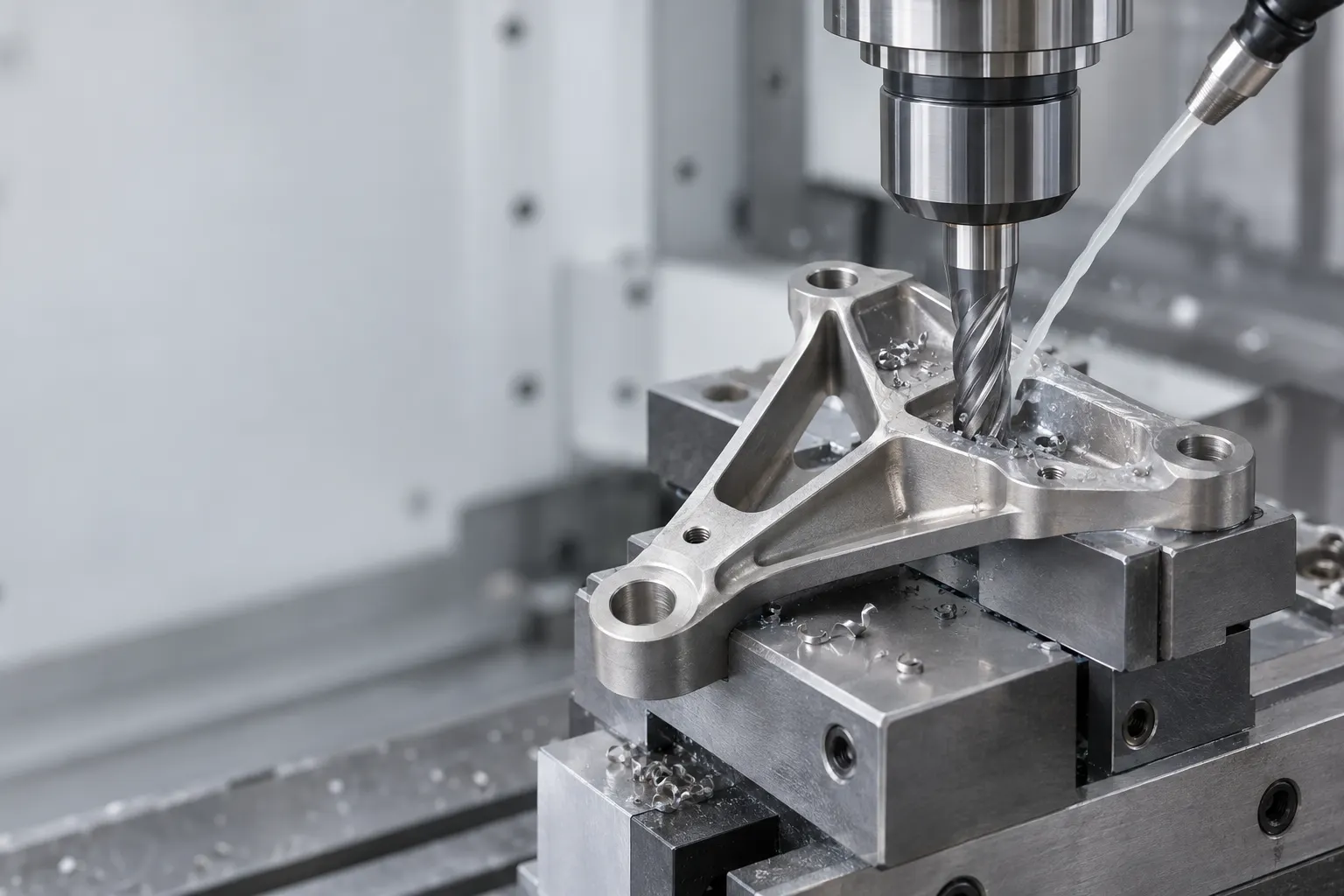
Titanium is chosen for its strength-to-weight ratio, corrosion resistance and, in some grades, biocompatibility. Those same properties make it slower and more sensitive to machine than aluminum or most steels: heat stays concentrated at the cutting edge because the material conducts it poorly, the lower stiffness lets thin walls and long features deflect, and the metal tends to gall against itself and against tooling. Most quote differences on titanium come from how clearly the RFQ separates the critical features from the rest.
Applicability
Titanium CNC Machining use cases
Aerospace, motorsport, marine and instrument parts where weight, strength, and corrosion resistance justify the material cost.
Commercially pure grades such as Grade 2 for corrosion-driven parts, and Ti-6Al-4V (Grade 5) where higher strength is needed.
Medical and laboratory components where the buyer specifies an implant-grade variant such as Ti-6Al-4V ELI and its own documentation rules.
Prototype and low-volume parts where machining from bar or plate is practical before any forging or casting route is considered.
RFQ inputs
RFQ inputs and drawing requirements
Grade and material specification
Name the grade and the specification the stock must meet (for example ASTM B348 for bar or ASTM B265 for plate, or the buyer’s own specification), and whether substitutions are allowed.
Stock condition and records
State the required condition, such as annealed, and whether mill certificates, heat traceability, or third-party test reports must ship with the parts.
Thin, deep, and threaded features
Mark thin walls, deep pockets, small holes, and threads, because these drive tool choice, setups, and inspection more than overall size does.
Finish and surface condition
Specify any anodizing for color or anti-galling, blasting, or polishing, and whether surface contamination or alpha case from earlier hot work must be removed and verified.
Inspection and quantity
List the critical dimensions and the report expected, plus the quantity and whether the order is a prototype, a bridge lot, or repeat production.
Constraints
Constraints and quote assumptions
- Titanium removes material more slowly than aluminum or free-machining steel, so cycle time and tooling are a larger share of the price.
- Thin walls and long slender features can deflect or chatter; the drawing should show which of them carry tight tolerances.
- Threads and sliding fits in titanium are prone to galling; state any coating, anodizing, or anti-seize requirement instead of leaving it to assembly.
- Fine titanium chips and dust are combustible, so grinding, polishing and chip handling follow controlled practice that can affect secondary operations.
- Material availability and certification requirements can set the schedule more than machining does, especially for implant grades.
Related manufacturing examples
Related manufacturing references

Precision Shaft
Precision Shaft is a geometry reference for long turned titanium parts, where straightness and fit diameters need explicit callouts; the material is confirmed per RFQ.
Review reference
Flanged Shaft Hub
Flanged Shaft Hub shows the mix of turned diameters and faces that, in titanium, makes setup rigidity and thread condition part of the quote.
Review reference
Stepped Shaft
Stepped Shaft illustrates shoulders and small diameters that deflect more in titanium than in steel; it is a geometry reference only.
Review referenceRelated pages
Continue the RFQ review
Materials hub
Compare titanium with aluminum, stainless steel and engineering plastics before fixing the material in the RFQ.
Open pagePrecision CNC machining
The core service page for milled and turned parts reviewed against material, tolerance, finish and inspection.
Open pageFirst article inspection report guide
What to request when titanium parts need a full first article report and material records.
Open pageFAQ
Titanium CNC Machining FAQs
Is titanium hard to machine?
It is slower and less forgiving than aluminum or most steels rather than simply “hard”. Poor heat conduction concentrates heat at the cutting edge, the material’s lower stiffness makes thin features deflect, and it tends to gall, so it needs sharp tools, rigid fixturing, and plenty of coolant. Parts are quoted with that in mind.
Should an RFQ specify Grade 2 or Grade 5 titanium?
Specify the grade your design and approvals are based on. Grade 2 is commercially pure titanium, chosen mainly for corrosion resistance and formability; Grade 5 (Ti-6Al-4V) is an alloy chosen for higher strength. They are not interchangeable without engineering approval, so the RFQ should say whether any substitute is allowed.
Which documents usually come with titanium parts?
Usually a mill certificate for the stock, tied to the heat or lot, plus the dimensional report the order calls for. Aerospace and medical buyers often add traceability, first article, or third-party test requirements; name them in the RFQ so they are quoted.
Can titanium parts be anodized?
Yes. Titanium anodizing is used for color identification and, in some specifications, to reduce galling. It differs from aluminum anodizing, so name the titanium specification and color or type you need, and mark any surfaces that must stay bare.
Material machining guide
Quote titanium parts from the grade, the records, and the critical features.
Send the drawing, the grade and material specification, the certificates required, and the features that carry the tight tolerances.
Start titanium RFQ