
Non-standard tooling pins
Custom Core Pins and Ejector Pins
Custom core pin and ejector pin RFQs should name the mold standard replaced, the length, head and tip form, material, hardness, and fit.
Short answer
Standard core pins and ejector pins are normally bought from the catalog of the mold standard the tool already uses. A custom precision core pin or ejector pin is worth quoting when the length, head, tip shape, venting, cooling, or material is not available from that catalog, and the RFQ should name the standard part it replaces or modifies.
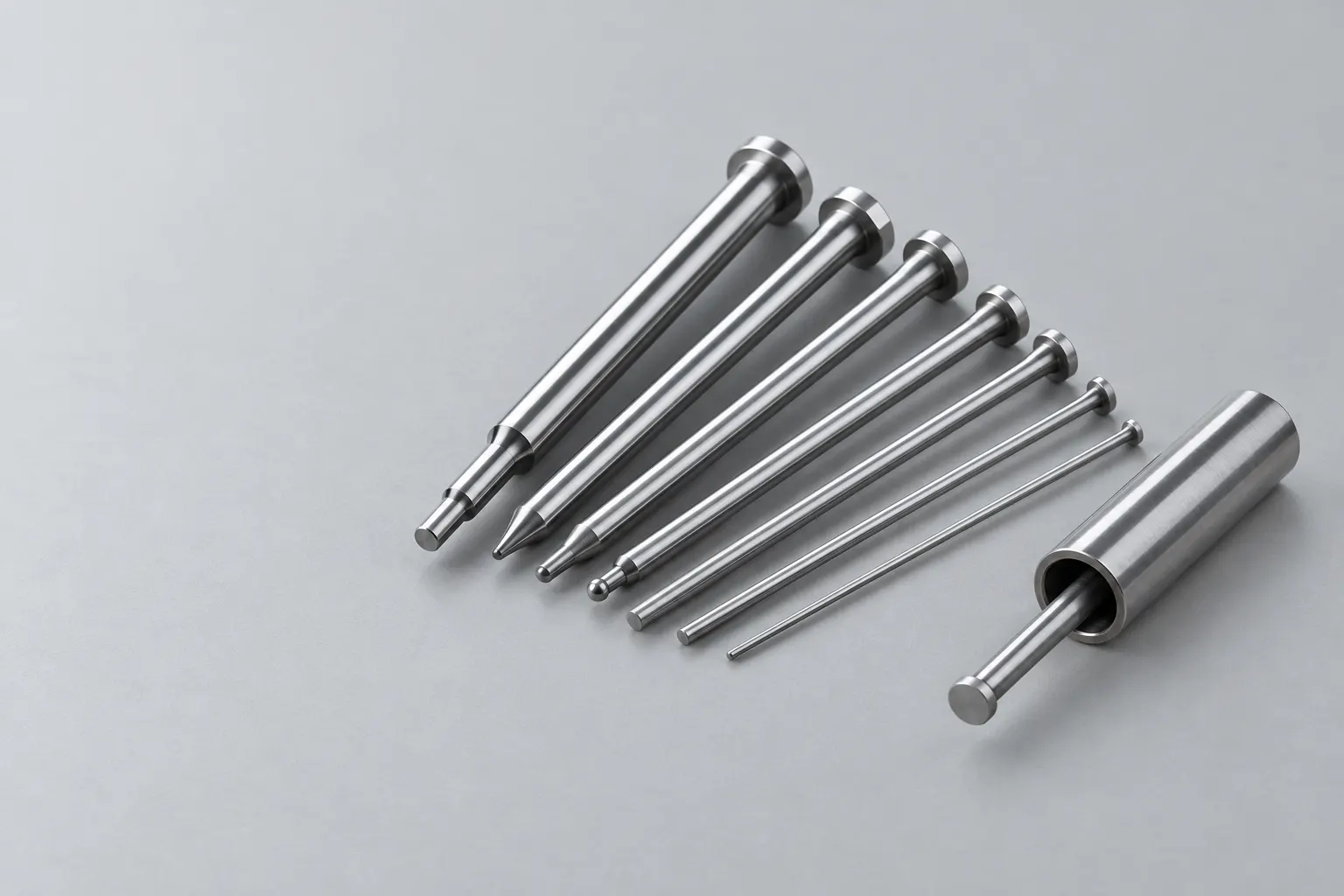
Pins look simple and are often the cheapest line on a tooling order, but they are also where small dimensional errors show up as flash, sticking, or broken pins. A custom pin usually differs from a catalog part in one or two features: a contoured or stepped tip that forms part of the molding surface, an anti-rotation flat or key on the head, a vented or sleeved design, a non-standard length, or a material such as beryllium-free copper alloy or carbide for heat or wear. The RFQ should say which features are custom and which follow the catalog standard.
Applicability
Custom Core Pins and Ejector Pins use cases
Injection molding core pins with stepped, tapered, or contoured tips that form holes or details in the molded part.
Injection mold ejector pins that need a contoured face, anti-rotation feature, non-standard length, or a fitted head.
Sleeve ejectors and core pin pairs where the pin and sleeve fit must be produced and inspected together.
Pins in heat- or wear-critical areas where the catalog material or hardness is not suitable.
RFQ inputs
RFQ inputs and drawing requirements
Standard being replaced
Name the catalog standard and part number the pin is based on, or state that no standard part applies.
Custom features
Mark the features that differ from the standard: tip contour, length, head form, anti-rotation flat or key, venting, or cooling.
Fit in the tool
Give the bore size and fit the pin runs in, and for sleeve ejectors the pin-to-sleeve clearance the design expects.
Material and hardness
Specify material, hardness, and any nitriding or coating, and whether the molding tip and the shank have different requirements.
Quantity and spares
State the quantity per tool and any spares, since pins are often ordered in sets with spares for a running tool.
Constraints
Constraints and quote assumptions
- Long, slender pins are sensitive to straightness and runout, so the drawing should state how and where those are checked.
- A contoured tip that forms part of the molding surface has to be oriented in the tool, which means an anti-rotation feature and an orientation datum.
- Pins finished to length at the mold shop should be ordered with stated extra length rather than to final size.
- Copper-alloy and carbide pins change the route, tooling, and inspection compared with hardened steel pins and should be called out early.
Related manufacturing examples
Related manufacturing references

Multi-Hole Pin Plate
Multi-Hole Pin Plate shows the plate a set of pins is located in, where hole position and fit decide whether pins run freely.
Review reference
Hole Pattern Plate
Hole Pattern Plate illustrates why pin bores and pin diameters should be toleranced as a fit pair.
Review reference
Micro-Hole Insert Plate
Micro-Hole Insert Plate is typical of fine-pin applications where straightness and small-diameter fits dominate the inspection plan.
Review referenceRelated pages
Continue the RFQ review
Precision injection mold components
The main service page for inserts, cores, and other drawing-controlled tooling components.
Open pageInjection mold lifters
Lifters share the ejector system with ejector pins and are often ordered with them.
Open pageTolerances and standards
How fits, runout, and straightness should be called out so a pin can be inspected without argument.
Open pageFAQ
Custom Core Pins and Ejector Pins FAQs
What is the difference between core pins and ejector pins?
A core pin stays fixed in the mold and forms a hole or recess in the molded part. An ejector pin is mounted on the ejector plate and pushes the part off the core when the mold opens. Some pins do both jobs, such as a core pin running inside a sleeve ejector.
When does a custom pin make more sense than a catalog pin?
When the catalog cannot supply the length, head, tip shape, venting, cooling, or material the tool needs. If the only change is length, many buyers instead order a catalog pin and cut it to length at assembly, which is usually cheaper.
What should be inspected on a custom core pin?
The diameter and fit size of the shank, straightness and runout along the length, the tip geometry against its datum, the head thickness and orientation feature, hardness, and the finish of the molding surface where it forms the part.
Non-standard tooling pins
Quote only the pin features the catalog cannot supply.
Send the pin drawing, the catalog standard it is based on, the bore fit, material and hardness, and the quantity including spares.
Start pin RFQ